Overview
I was part of EE's Accessibility team, embedded within the Loop Design System team to provide dedicated accessibility support - a gap that had previously gone unfilled. The Accessibility team had been working towards RNIB Tried & Tested accreditation, but without dedicated expertise closely integrated into the Design System team's day-to-day work, progress had stalled.
My prior background in product design - and earlier experience delivering services to the GDS Service Standard at Kirklees Council - meant I was well placed to plug this gap. I could speak the language of the design team, engage with their tools and processes directly, and translate accessibility requirements into practical design guidance without adding friction. This increased the team's overall readiness for accreditation and helped accelerate progress from the point I joined.
My Role
As Design Systems Accessibility Lead, my responsibilities spanned the full delivery pipeline - from early design review through to post-release auditing.
- Accessibility auditing - reviewing features against WCAG 2.2 criteria throughout the release cycle
- Design guidance - writing accessibility documentation within the Loop design system, making it practical and actionable for designers
- Designer support - working directly with the design team to translate WCAG requirements into real design decisions, leveraging my design background to bridge the gap
- Fortnightly a11y and DS sync - I ran and owned a fortnightly call between the Accessibility and Design System teams, establishing myself as the bridge between both and creating a regular, dedicated space for RNIB-related issues to be raised and discussed with the wider group
- Stakeholder management - running monthly compliance score review calls and attending regular catch-ups across design, development, QA, and product
- RNIB accreditation - aligning RNIB feedback loops with EE's release cadence and driving the process maturity needed to achieve and maintain accreditation
"Our approach was grounded in metrics and evidence, but also in empathy. A multidisciplinary team that not only knows the standards, but genuinely cares about all our customers, made this possible. I'm incredibly proud of my team: Joanne Large, Nat Betts, Sam Overson and Sean Randall. Their expertise, persistence, professionalism, and heart were instrumental in achieving this milestone."
EE Leadership
The Challenge
EE had a solid internal accessibility review process that matched the release cadence. The challenge was that RNIB's external feedback cycle didn't align with it. Feedback would often arrive at a point in the release cycle where implementing fixes required negotiating exemptions with stakeholders - a time-consuming process that introduced risk and friction for every affected release.
Getting stakeholders to grant exemptions required building trust, demonstrating consistent progress, and making the business case that accessibility was worth schedule disruption. This was as much an organisational challenge as a design or technical one.
The internal process was solid - the gap was between EE's release cadence and RNIB's feedback cycle. Closing that gap was the key to accreditation.
What I Did
Owning the bridge between Accessibility and Design Systems
I established and ran a fortnightly sync between the Accessibility and Design System teams - a call I owned end to end. This created a regular, predictable space for RNIB-related issues to surface and be discussed with the right people, rather than being handled ad hoc. Over time this positioned me as the consistent link between both teams and helped build the cross-functional trust the accreditation process required.
Building early-warning touchpoints
Alongside the fortnightly sync I attended regular catch-ups across design, development, QA, and product - ensuring issues were visible early in the cycle. Surface things early and they're design decisions. Surface them late and they're incidents.
Using design systems as an accessibility lever
A consistently adopted design system is an accessibility multiplier - if the component is right, every instance of it is right. I advocated for design system adoption across teams, framing it not just as a consistency tool but as a compliance mechanism. Accessible components at the system level scale to accessible products at the platform level.
Aligning RNIB feedback to the release cadence
This was one of the trickiest operational problems. RNIB feedback cycles didn't naturally align with EE's release schedule, which meant feedback would sometimes arrive after a release had already gone out. I worked with stakeholders to build a process that anticipated this mismatch - creating a feedback pipeline that reduced last-minute surprises and gave teams time to act.
WCAG 2.2 AA Compliance - 18 Month Score Journey
Outcome
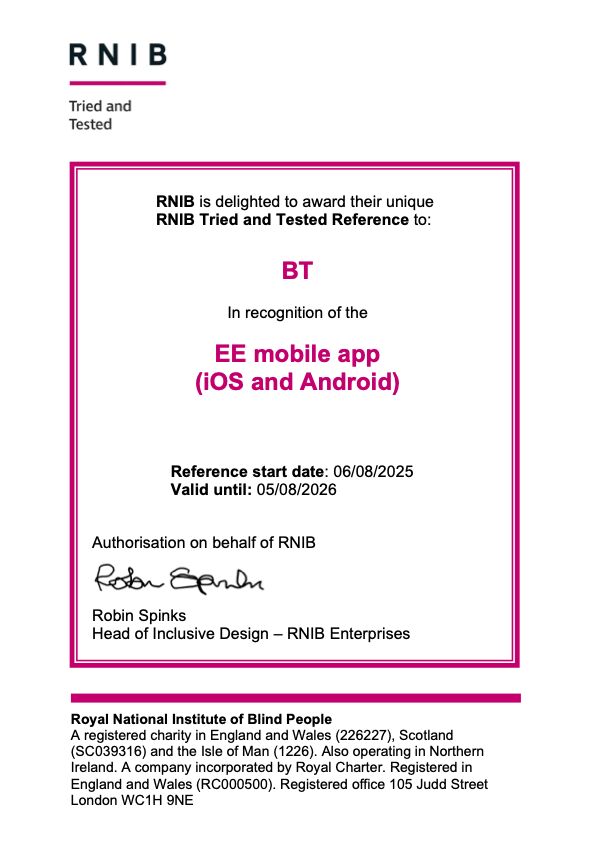
EE was awarded RNIB Tried & Tested accreditation - and I was named in the official press release. The compliance improvement was measurable: scores that had previously swung between 30% and 80% stabilised in the 80-85% range.
The more meaningful outcome was cultural. The improvement in process maturity directly influenced a company-wide accessibility target increase to 95% - a recognition that the team's approach had become credible enough to set a higher bar for the entire organisation. Repeated accessibility issues declined. Colleagues across design and development reported pride in being part of the achievement. Accessibility shifted from a compliance checkbox to something the team owned.
How It Happened
-
Compliance scores volatile between 30-80%. RNIB accreditation aspirational but stalled. No dedicated bridge between the Accessibility and Design System teams.
-
Established fortnightly a11y and DS sync. Built stakeholder touchpoints. Started working directly with designers on WCAG translation.
-
Cross-team rhythm established. Repeated issues declining. RNIB feedback pipeline aligned to release cadence.
-
Scores stabilised at 80-85%. Named in RNIB press release. Company-wide target raised to 95% - a direct reflection of process maturity.
Looking Back
Aligning RNIB feedback earlier to the release cycle was the biggest structural gap. Given more time at the outset, I would have pushed harder to formalise a feedback SLA with RNIB from day one - rather than managing it reactively as issues arose. A defined agreement upfront would have removed a lot of the late-cycle pressure that led to exemption requests.