Overview
In 2022, as blockchain emerged as a significant topic in financial services, Lloyds Banking Group wanted to explore whether the technology could address pain points in their cross-border payments process. Rather than approaching this as a purely technical question, LBG used design thinking methodology to understand the problem space first - a deliberate choice to put human insight before technical assumption.
The team operated as if they were a lean startup within the bank - many contributors were volunteers, working on this alongside their contracted roles. The project was led by a senior manager within LBG's Blockchain and Digital Currencies team, who I worked closely with throughout. A call went out across LBG's design community and I put my hand up. I had only recently joined the business as a Graduate Product Designer in the Homes and Mortgages team, but I had a genuine interest in blockchain beyond its cryptocurrency applications and wanted to see how an organisation of LBG's scale approached emerging technology.
Organisation
One of the UK's largest financial institutions
Technology
Blockchain for cross-border payments
My status
Graduate designer, weeks into the role, volunteering on top of contracted work
Experiment Objectives
Four clear objectives shaped the experiment from the outset:
- Validate blockchain implementation - assess the feasibility and potential benefits of incorporating blockchain into the bank's cross-border payment infrastructure
- Understand the current process - gain a deep understanding of the existing cross-border payment journey, highlighting pain points and opportunities
- Ideation and solution generation - generate innovative solutions leveraging blockchain to address identified pain points
- Proof of concept - select and define a PoC solution that demonstrated the real potential of blockchain in improving the payments journey
My Role
I worked alongside two other volunteers to plan and run both workshops. My involvement spanned preparation and delivery - helping design the workshop structure with stakeholders to ensure we were asking the right questions of the right people, then co-facilitating the sessions on the day and participating in the PoC selection process.
Workshop 1 - Understanding the Current Process
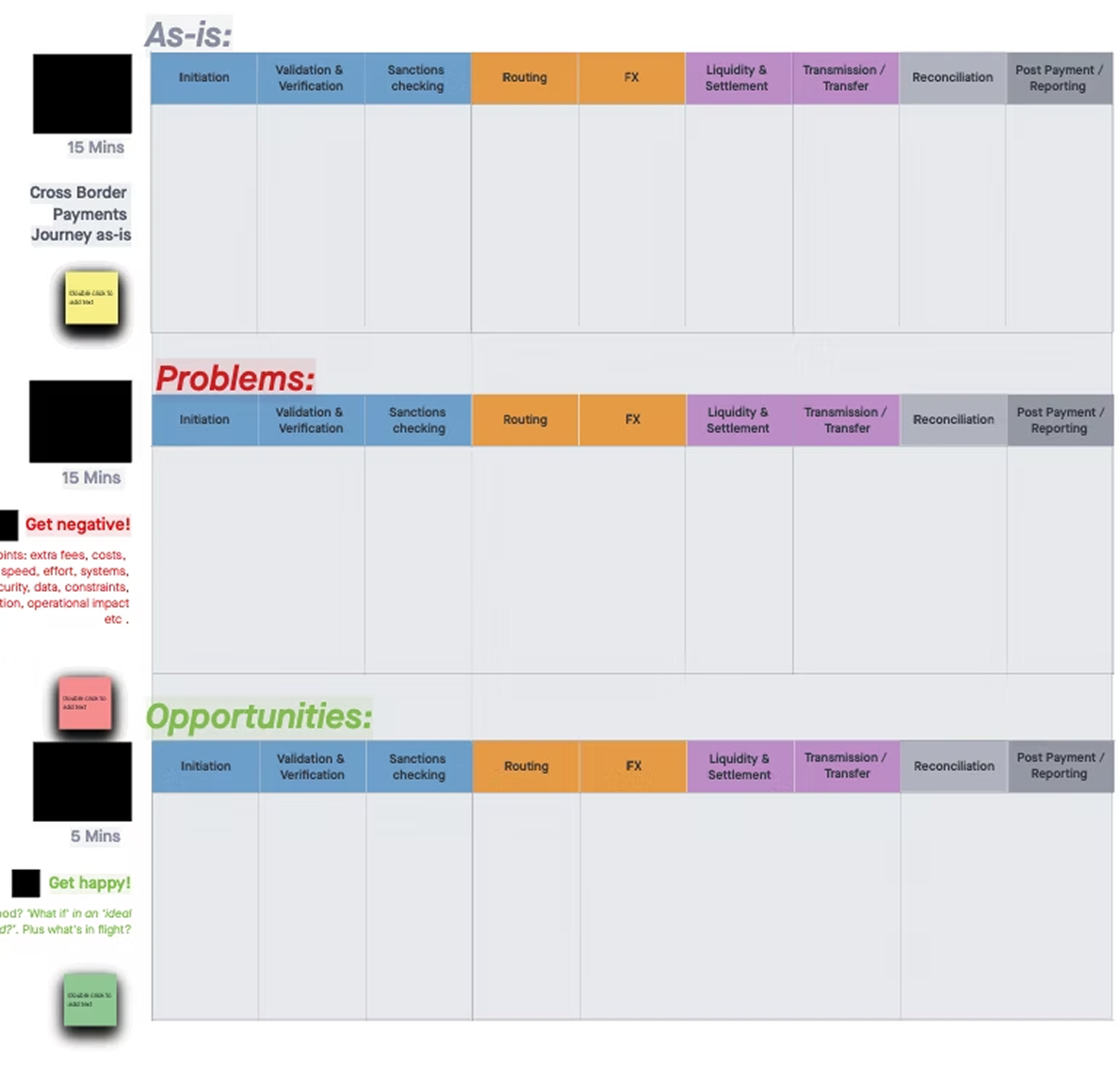
The first workshop focused on mapping the existing cross-border payments journey and surfacing where it broke down. We ran multiple sessions over 2-3 weeks, deliberately keeping group sizes small - between 2 and 8 participants - so every voice in the room could contribute meaningfully. Strict time constraints were placed on each section of the workshop, which kept conversations topical and productive.
LBG's scale meant we could bring in genuine domain experts from teams with deep, lived knowledge of the payments process. Teams we worked with included:
Sessions were run on Adobe Freehand boards. A member of the design team would share their screen with participants while other facilitators added notes in the background - a deliberate choice to keep the conversation natural and unguarded rather than led or directed. Key pain points identified included high transaction fees, lengthy settlement times, and high numbers of false positives caused by manual verification processes.
Synthesis
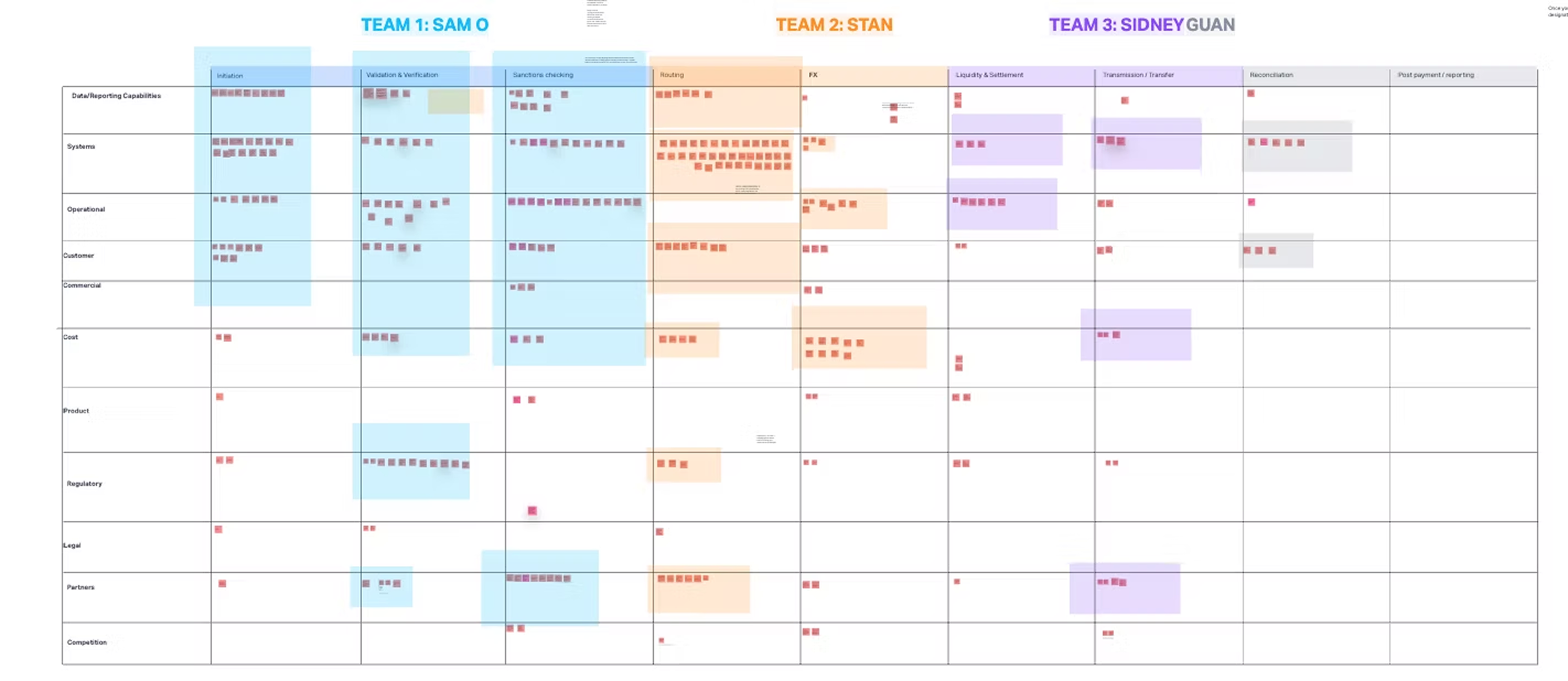
After the sessions, the design team aggregated pain points from all workshops onto a single central journey map. From there we identified clusters - recurring themes pointing to systemic rather than isolated problems - and produced a low-fidelity heat map visualising where friction concentrated across the payments journey. This heat map then provided the foundation for Workshop 2.
Aggregate pain points
All pain points from individual sessions brought together onto a single central journey map.
Identify clusters
Recurring themes identified - pointing to systemic friction rather than one-off issues.
Heat map
Low-fidelity heat map produced to visualise where friction concentrated across the payments journey.
Handoff to Workshop 2
Heat map used as the evidence base for the root cause analysis and ideation session with key stakeholders.
Workshop 2 - Root Cause Analysis and Ideation
The second workshop used the heat map as its starting point. Working with key stakeholders, the team conducted a root cause analysis of the clustered pain points - drilling beneath the surface symptoms to identify the underlying issues driving inefficiency in cross-border payments. Five root causes were identified:
- Complex regulatory landscape - diverse requirements across countries create compliance delays and increased costs
- Manual verification processes - identity and compliance checks involving manual documentation introduce friction and delays
- Inefficient intermediary processes - reliance on multiple correspondent banks introduces manual processes and slows settlement
- Lack of transparency - limited visibility into payment status creates uncertainty for all parties
- High transaction fees - multiple intermediaries, each charging for their services, compound costs significantly
With the root causes established, the team moved into ideation - brainstorming solutions that leveraged blockchain technology to address each one.
Proof of Concept Selection
Three PoC solutions were proposed during the ideation session:
- Centralised identity verification and KYC on the blockchain - securely storing user KYC information to eliminate repetitive checks across transactions
- Distributed ledger technology for transparent transaction records - a shared, tamper-proof transaction history accessible to all authorised parties
- Tokenisation of assets for efficient cross-border payments - digital representations of assets transferable instantly across borders, reducing intermediary dependency
The selected proof of concept was a cross-border payments passport - a blockchain-based identity verification system that would securely store and verify user identities, eliminating the need for repetitive KYC checks and reducing false positives in the process.
The selection was made by anonymous dot vote at the end of the ideation session - ensuring every participant could vote freely without fear of influence or repercussion. I was involved in both the ideation and the vote. The PoC itself was never built before I left LBG, but the decision to pursue it was a direct output of the design thinking process the team ran.
Outcome
The two workshops produced a clear, evidence-based foundation for LBG to evaluate blockchain's potential in cross-border payments - grounded in the perspective of domain experts rather than assumptions. The process surfaced five root causes, generated three PoC concepts, and reached a consensus decision via anonymous vote on the most promising direction to pursue.
I left LBG before seeing the proof of concept come to fruition. What I can speak to is the quality of the process - rigorous, human-centred, and conducted inside one of the UK's most complex financial organisations. LBG continued to invest in and publish on blockchain and distributed ledger technology in the years following, suggesting the question the workshops helped frame was one worth asking.
Looking Back
This project sits outside my core visual design and accessibility work, but it represents something I value equally - the willingness to engage with ambiguous, strategic problems and bring design thinking to spaces where it isn't the default.
Volunteering as a graduate, weeks into a new role, to work alongside senior practitioners on a question this complex was a deliberate stretch. It gave me an early window into how an organisation of LBG's scale evaluates emerging technology - and reinforced the value of approaching technical questions with human-centred methods rather than jumping straight to solutions.
It also confirmed an instinct I've carried throughout my career: the most interesting design problems aren't always the ones with a clear brief. Sometimes the work is just figuring out what the right questions are.